Agentic AIOps moves IT operations from insight to action, automatically.
Legacy AIOps helps teams detect and analyze issues, but still relies on humans to fix them, often too late to prevent impact.
Agentic AIOps goes further by autonomously deciding and executing remediation, reducing downtime, risk, and manual effort.
By combining real-time observability, AI-driven decision-making, and self-healing actions, it protects revenue and customer experience at scale.
The result: faster resolution, fewer incidents, lower operational risk, and IT teams free to focus on strategic work instead of firefighting.
Real problems need real solutions. We’ve all heard the same lofty claims about AI in IT operations: “Reduce alert noise” and “Detect anomalies.” While these sound great on paper, they often fall flat when critical systems fail during peak buying seasons or a major security threat goes undetected.
E-commerce businesses lose revenue by the second when their sites go down, telecom companies juggle 100,000+ daily alerts, and managed service providers handle hundreds of client environments with unique configurations—none of which can afford protracted downtime or failures.
Conventional AIOps has undoubtedly brought some intelligence to IT operations, offering event correlation, anomaly detection, and root cause analysis. But most AIOps tools still stop short of autonomous resolution.
By the time IT teams sift through alerts, interpret data, and propose fixes, the damage may already be done—transactions are lost, customers are frustrated, and reputations take a hit.
In the following sections, we’ll explore why AI autonomy has become essential for IT. If you’re already convinced and want to see agentic AIOps in action, feel free to skip ahead to “Key use cases of agentic AI in IT operations.” Otherwise, keep reading as we explore the critical differences between conventional and agentic AIOps and why this shift is a necessary evolution for IT operations.
What AIOps Is Used for in IT Operations Today
Artificial Intelligence for IT Operations (AIOps) refers to the use of machine learning and advanced analytics to help IT teams make sense of massive volumes of operational data.
Modern IT environments generate signals across logs, metrics, events, and traces far more than human teams can process in real time.
AIOps platforms analyze this data to identify meaningful patterns, reduce noise, and accelerate response when issues arise.
AIOps Use Cases in IT Operations
AIOps is widely used to help IT teams manage complexity, scale operations, and respond faster to incidents. Its most common use cases today include:
Alert noise reduction and deduplication: Correlating related alerts across systems to reduce noise and prevent alert fatigue.
Event correlation and incident formation: Grouping signals from logs, metrics, and events into actionable incidents with context.
Root cause analysis (RCA): Identifying the underlying source of issues across complex, distributed environments.
Predictive analytics and proactive monitoring: Detecting performance degradation and anomalies before they impact users or revenue.
Incident response automation: Triggering predefined workflows or remediation steps to reduce manual intervention.
Capacity planning and resource optimization: Forecasting demand and adjusting resources to avoid over- or under-provisioning.
IT service management (ITSM) enhancement: Improving ticket triage, routing, and resolution within service management workflows.
Security anomaly detection: Identifying unusual behavior patterns that may indicate threats or policy violations.
Moving Beyond Conventional AIOps
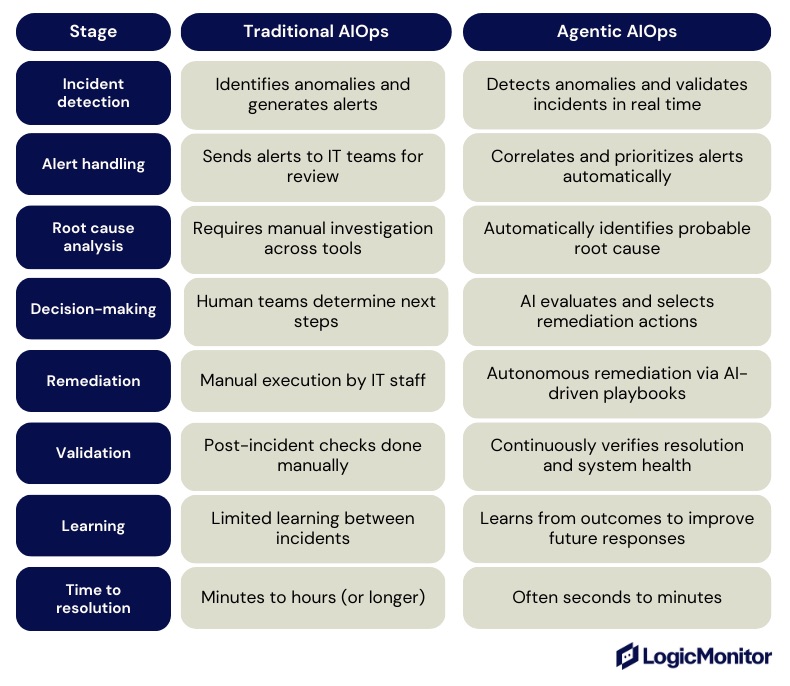
Conventional AIOps excels in event correlation, anomaly detection, and root cause analysis, but it stops short of resolving issues. Most AIOps solutions operate reactively, identifying problems but leaving IT teams to manually troubleshoot, wasting hours sifting through alerts.
Consider a financial services company during a fraud audit. Delayed resolutions here could result in regulatory fines, missed compliance deadlines, or service degradation that violates customer agreements.
Across industries, reliance on manual interventions increases operational risk and financial impact. Your business remains vulnerable, hoping nothing breaks when it matters most.
The Shift toward Agentic AIOps
Agentic AIOps represents a fundamental shift from AI-assisted to AI-driven operations. Instead of providing insights for humans to act on, it takes autonomous action to resolve issues. It’s the difference between getting a smoke alarm warning and having a sprinkler system automatically extinguish the fire.
While legacy tools passively monitor and alert, agentic solutions actively remedy problems. Their self-learning models continuously refine decisions over time, improving efficiency with each incident they handle.
Conventional AIOps might generate an alert about performance degradation, requiring manual intervention. Agentic AIOps, however, would autonomously schedule maintenance during planned downtime, dispatch technicians with the right parts, and redistribute workloads to maintain production efficiency.
What was once a multi-day process requiring numerous human decisions becomes an autonomous response measured in minutes.
Why Autonomy Matters in IT Operations
By applying machine learning to logs, events, logs, and traces, legacy AIOps reduces alert noise, accelerates root cause analysis, and helps teams respond to incidents faster and more consistently.
That value is well established.
However, conventional AIOps stop at the insight level. They still rely on human teams to interpret recommendations, decide what to do next, and execute remediation steps.
As environments grow more dynamic—autoscaling infrastructure, frequent releases, seasonal demand spikes—this human dependency becomes the limiting factor.
Agentic AIOps addresses this gap by combining intelligence with execution.
Instead of only identifying issues, agentic systems can plan, decide, and act autonomously within defined guardrails. This allows IT operations to move from “assistive” automation to self-healing, proactive operations, where issues are resolved before they escalate into outages or customer impact.
This shift:
Reduces operational risk by eliminating delays between detection and action
Improves productivity by removing repetitive decision-making from human workflows
Enables IT teams to scale operations without scaling headcount
Turns AIOps from a diagnostic tool into an operational control system
This is why many organizations are now evaluating not just whether to use AIOps, but how autonomous their AIOps platform needs to be to support modern infrastructure.
How Agentic AIOps Works
Agentic AIOps transforms IT operations by emulating the reasoning processes of your most experienced engineers—rapidly and at scale.
Here’s a clear breakdown of how an agentic system might operate:
1. Data Ingestion & Integration
Agentic AIOps starts by aggregating both structured data, such as logs, metrics, traces, and events, and unstructured data, including incident reports and team communications.
It gathers observability information across cloud, hybrid, and on-premises environments, utilizing leading observability frameworks like OpenTelemetry and Prometheus to ensure real-time, end-to-end visibility.
Why Data Integration and Enrichment Are Critical for Autonomous AIOps
Modern IT environments generate data across dozens of systems, logs, metrics, traces, events, configuration data, and service records, often in different formats and delivery modes.
Because signals arrive at different speeds, from different tools, and with inconsistent structure, integrating this data is a non-trivial challenge across hybrid and multi-cloud environments.
Beyond ingestion, effective AIOps depend on data enrichment, adding context that explains how systems, services, and assets relate to one another.
This includes understanding:
Application dependencies
Infrastructure topology
Ownership
Recent changes
Business criticality
Without this context, AI systems can detect anomalies but struggle to determine which signals matter, what caused them, or how risky a given action might be.
Agentic AIOps relies on this enriched, cross-domain view to act safely and accurately.
By correlating telemetry with topology and asset context—often sourced from service maps, configuration data, or CMDB-like systems—agentic platforms can distinguish upstream causes from downstream symptoms, assess blast radius, and select appropriate remediation actions.
This is what allows autonomous systems to move beyond alerting and into reliable self-healing, without increasing operational risk.
2. AI & Machine Learning Analysis
Once data is aggregated, agentic AIOps apply advanced AI and machine learning techniques such as trend analysis, time-series forecasting, and baseline deviation detection to identify anomalies, predict performance degradation, and determine root causes within complex, distributed systems.
Continuous, real-time monitoring allows these models to flag early warning signals, often hours or days before issues escalate into outages or customer-facing incidents.
Unlike static rule-based systems, it proactively predicts incidents, continuously refining its predictive capabilities based on evolving datasets and past incident outcomes.
3. Autonomous Decision-Making & Self-Healing
Agentic AIOps sets itself apart by autonomously evaluating potential remediation strategies, predicting their effectiveness, and selecting the optimal solution without requiring human intervention. It leverages AI-powered playbooks that combine learned behaviors with predefined rules, enabling automatic and intelligent incident resolution.
4. Reducing Alert Fatigue & Noise Filtering
To combat alert fatigue, the system intelligently filters redundant or low-priority alerts through advanced event correlation techniques, surfacing only genuinely critical issues. This dramatically reduces alert noise, allowing IT teams to respond swiftly and effectively to true incidents, improving overall productivity and focus.
5. Continuous Feedback Loop
Agentic AIOps goes beyond static automation. After incidents are autonomously resolved, the system continually monitors outcomes, learns from each event, and adapts to evolving conditions. This continuous improvement ensures increasing accuracy and efficiency in future incident detection and resolution.
Key Use Cases of Agentic AI in IT Operations
Now that you know the role of agentic AI in ITOps, let’s look at its main use cases.
Automated Incident Detection & Resolution
Agentic AIOps autonomously identifies and resolves incidents at the earliest stages, going beyond traditional AIOps solutions, which primarily focus on detection and alerting.
For example, during flash sales, an online retailer might repeatedly experience performance slowdowns, leading to abandoned carts and lost revenue. With agentic AIOps, the system can autonomously detect database bottlenecks and independently scaled connection pools, optimized caching, and improved query efficiency in real-time.
Root Cause Analysis & Proactive Issue Prevention
One of the most powerful capabilities of agentic AIOps is its ability to cut through complexity and identify the true source of problems across distributed environments.
These systems excel at detecting subtle IT and network anomalies, managing alert storms, and providing immediate root cause identification—tasks that would take human teams hours or days to complete.
Here’s how event correlation and RCA work:
1. Ingest signals: Pull telemetry across infrastructure, apps, cloud services, and ITSM context to build a shared view of “what changed.”
2. Normalize and enrich data: Standardize formats and attach context like service ownership, topology/dependencies, recent changes, and known maintenance windows.
3. Correlate and compress alerts into incidents: Group related alerts (same symptom chain, shared dependency, or time-linked patterns) so teams see one incident instead of hundreds of noisy signals.
4. Rank likely root causes: Score candidates based on impact, blast radius, historical similarity, and dependency position (upstream causes rank above downstream effects).
5. Recommend or execute remediation: Traditional AIOps suggests next steps. Agentic AIOps can trigger a playbook automatically (with guardrails) to contain and resolve the issue.
6. Validate resolution and learn from outcomes: Confirm the fix reduced error rates/latency and didn’t create regressions—then feed the outcome back into future correlation and RCA.
To offer a real-life customer example in context, intermittent disruptions in a manufacturing production line were autonomously traced by agentic AIOps to subtle network anomalies.
The system then autonomously optimized network configurations, directly preventing approximately $175,000 in monthly production losses.
Self-Healing It & Remote Infrastructure Monitoring
Self-healing agentic AIOps autonomously monitors, repairs, and optimizes infrastructure, advancing beyond traditional monitoring tools that rely heavily on manual intervention.
For example, a global financial services provider uses agentic AIOps when early-stage database performance issues arise in their payment processing systems.
The platform autonomously redistributes processing loads, optimizes queries, and provisions additional resources, achieving significant uptime improvements.
Predictive Capacity Planning and Resource Optimization
Traditional capacity planning relies on static thresholds, manual forecasting, and overprovisioning to stay safe, which may drive unnecessary cloud spend without guaranteeing performance.
However, agentic AIOps applies predictive analytics and real-time monitoring to continuously forecast demand, identify emerging bottlenecks, and autonomously adjust resources before performance degrades.
By combining historical usage patterns with live telemetry, these systems can scale infrastructure up or down automatically, balancing performance, availability, and cost without requiring human intervention.
Agentic AIOps supports capacity and cost optimization by:
Predicting demand spikes using time-series analysis and trend forecasting
Automatically scaling compute, storage, and network resources in cloud and hybrid environments
Preventing overprovisioning during off-peak periods
Reducing cloud waste and supporting FinOps cost control initiatives
For example, during seasonal traffic surges or flash sales, agentic AIOps can proactively provision additional capacity ahead of demand, then safely decommission excess resources once traffic normalizes. This would protect user experience while keeping cloud costs in check.
ITSM Management & Digital Performance Monitoring
Agentic AIOps revolutionizes IT Service Management by applying real-time monitoring and full-stack observability to automate ticket triage, classification, and resolution.
Through application monitoring and comprehensive performance analytics, these systems dramatically improve operational efficiency while ensuring optimal digital experiences.
While incident management is often the most visible ITSM function, agentic AIOps extends automation and intelligence across the broader IT service lifecycle.
Here’s how:
Change management: Agentic AIOps assesses the potential impact of proposed changes by analyzing historical incidents, dependency maps, and recent system behavior.
Problem management: By correlating recurring incidents over time, agentic AIOps can surface underlying problems that may not be obvious during day-to-day operations.
Service request fulfillment: Common service requests, such as access provisioning, configuration updates, or routine maintenance, can be handled automatically using predefined workflows, reducing service desk workload and improving response consistency.
Agentic AIOps integrates with existing ITSM platforms (such as ServiceNow or Jira Service Management) to enrich tickets with context, automate routing, and maintain a complete audit trail without forcing teams to replace their existing ITSM tools.
Security Event Detection & Response
Agentic AIOps enhances cybersecurity posture by detecting and responding to threats in real-time, often addressing vulnerabilities before security teams could even begin analysis.
The technology’s ability to continuously monitor, immediately identify suspicious patterns, and execute predefined security protocols provides a formidable defense against emerging threats.
Detecting Known and Unknown Threats
Unlike signature-based security tools that rely on predefined rules, agentic AIOps establish behavioral baselines across systems, users, and network activity.
By learning what “normal” behavior looks like over time, these systems can detect subtle deviations such as unusual access patterns, unexpected traffic spikes, or anomalous process behavior that may indicate emerging threats.
This approach is particularly effective for identifying zero-day attacks and previously unseen threats, where no known signatures exist.
Instead of waiting for threat intelligence updates, agentic AIOps flags behavior that deviates from established baselines and evaluates risk in real time.
Automated Containment and Response Actions
Once a potential threat is identified, agentic AIOps can execute predefined security playbooks autonomously.
Depending on severity and policy guardrails, this may include isolating affected workloads, throttling suspicious traffic, revoking access credentials, or escalating incidents to security teams with full contextual detail.
By containing threats early, often before lateral movement occurs, organizations can significantly reduce blast radius and downstream impact.
Faster response means lower breach costs. As breaches average $4.4M, AI-assisted security analytics reduce response times by 108 days, limiting damage and financial impact.
Protecting User and Customer Experience with Agentic AIOps
For end users and customers, IT issues are experienced as slow checkouts, failed transactions, buffering streams, or unavailable services. Even brief disruptions can erode trust and damage brand perception.
By detecting issues earlier and resolving them autonomously, agentic AIOps helps organizations minimize customer-facing impact.
Performance degradation can be addressed before it becomes visible, infrastructure can scale ahead of demand spikes, and incidents can be contained without disrupting digital experiences.
This means:
Fewer service disruptions during peak usage periods
Faster checkout and transaction processing for e-commerce and financial services
Uninterrupted streaming and application performance for digital and SaaS platforms
Reduced customer support volume driven by IT-related issues
By shifting from reactive firefighting to proactive, autonomous operations, agentic AIOps ensures that IT reliability translates directly into better user and customer experiences when demand is highest.
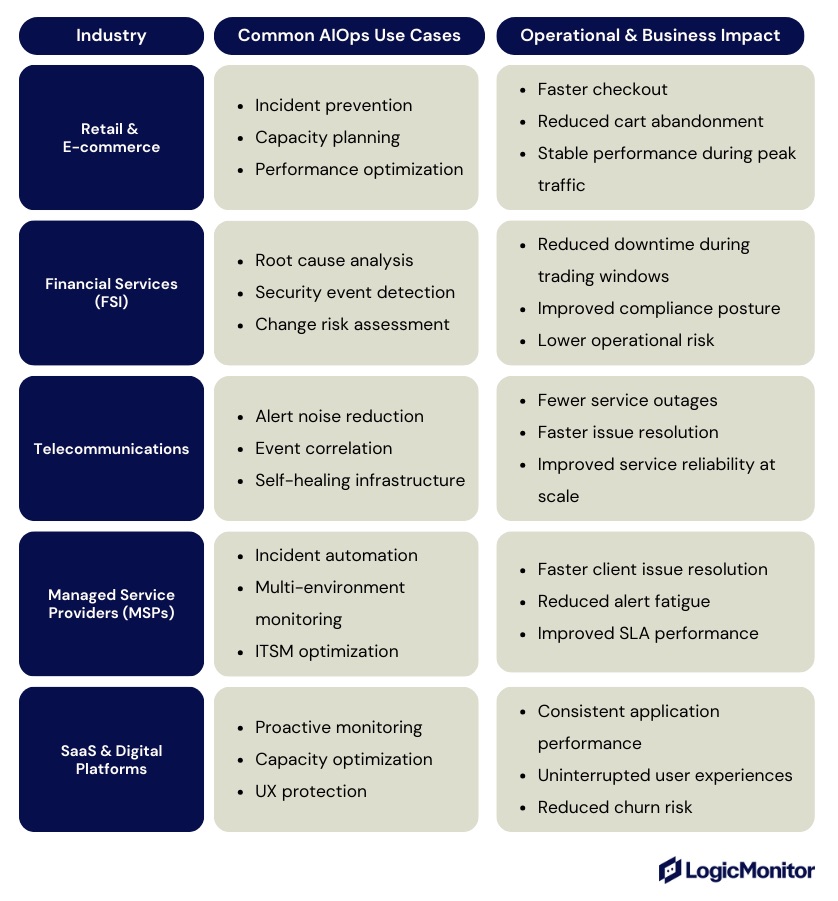
Agentic AIOps Use Cases by Industry
While the underlying AIOps capabilities are consistent, the way organizations apply them varies by industry. Different operating models, risk profiles, and demand patterns shape which use cases matter most and where autonomous action delivers the greatest impact.
Making the transition to agentic AIOps
Moving from traditional to agentic AIOps isn’t about replacing your team with AI—it’s about having a strategy and empowering your people with tools to manage modern infrastructure complexity. The transition requires thoughtful planning and execution rather than wholesale transformation.
Begin by identifying a single business-critical system where downtime directly impacts revenue. Apply agentic capabilities to this focused area first, measure results rigorously, and expand gradually based on demonstrated value. Most successful organizations start their journey with targeted implementations in high-impact areas such as automated database performance optimization, self-healing network infrastructure, predictive capacity management, or autonomous security incident response.
The critical factor in successful adoption is selecting use cases where autonomous action delivers clear business outcomes. Look for opportunities to protect revenue streams, reduce operational risk, or enhance customer experience. Document these benefits with quantifiable metrics to build momentum and organizational support for broader implementation.
Establish guardrails and oversight mechanisms as you progress. Ensure IT teams understand the system’s capabilities and limitations, creating appropriate human checkpoints for critical decisions while allowing the AI to handle routine issues independently. This balanced approach maintains control while maximizing the efficiency benefits of autonomous operations.
Edwin AI solves ITOps biggest challenges with agentic AI.
Agentic AIOps is a strategic imperative
The shift from conventional to agentic AIOps delivers three critical business outcomes:
Protection of revenue streams through dramatic reduction in system downtime
Significant decrease in operational risks through proactive issue prevention
Liberation of IT talent from reactive firefighting to strategic innovation
Organizations embracing autonomous IT operations build resilient infrastructure that protects business continuity during critical moments and delivers consistently superior digital experiences for customers. With demonstrated results including less downtime, faster issue resolution, and prevention of major incidents, the business case is clear.
In a world where seconds of downtime translate directly to lost revenue and damaged reputation, agentic AIOps provides the autonomous protection modern businesses require.
Ready to transform your IT operations from a business constraint to a strategic advantage? Request a demo today.
By Margo Poda
Sr. Content Marketing Manager, AI
Disclaimer: The views expressed on this blog are those of the author and do not necessarily reflect the views of LogicMonitor or its affiliates.