What a Forrester TEI study on Edwin AI actually tells IT leaders—and how to use it
A commissioned Forrester Consulting TEI™ study gives IT leaders a financial framework for evaluating Edwin AI’s impact on alert noise, RCA, MTTR, SLA risk, and operational efficiency.
This blog helps IT leaders use the Forrester Consulting TEI™ study as a practical framework for evaluating Edwin AI in their own environments.
Use the TEI study to glean the detail behind the 313% ROI headline and understand where the modeled value came from
Compare the study’s assumptions against your own incident workflow, including alert noise, RCA effort, escalations, downtime, SLA exposure, and engineering capacity.
Bring the study into budget and planning conversations as a structured way to connect incident response improvements to business impact.
A Total Economic Impact™ study is useful for one, critical reason: it takes a broad technology claim and turns it into a financial and operational framework.
That matters in AI for IT operations because the market is crowded with claims. Every platform says it reduces noise. Every platform says it improves efficiency. Every platform says it helps teams move faster. What IT leaders need is a clearer way to separate vague value from actual impact.
That is why the commissioned Forrester Consulting study, The Total Economic Impact™ Of LogicMonitor’s Edwin AI, deserves a closer read.
LogicMonitor commissioned Forrester Consulting to conduct a Total Economic Impact™ study to examine the potential return on investment enterprises may realize by deploying Edwin AI. Forrester interviewed seven decision-makers at five organizations using Edwin AI, then aggregated those findings into a composite organization to model costs, benefits, flexibility, and risk over three years. The composite organization represents a multinational enterprise with $2.5 billion in annual revenue, 5,000 employees, and business-critical applications running across hybrid cloud and on-premises infrastructure.
For that composite organization, the study found that Edwin AI delivered:
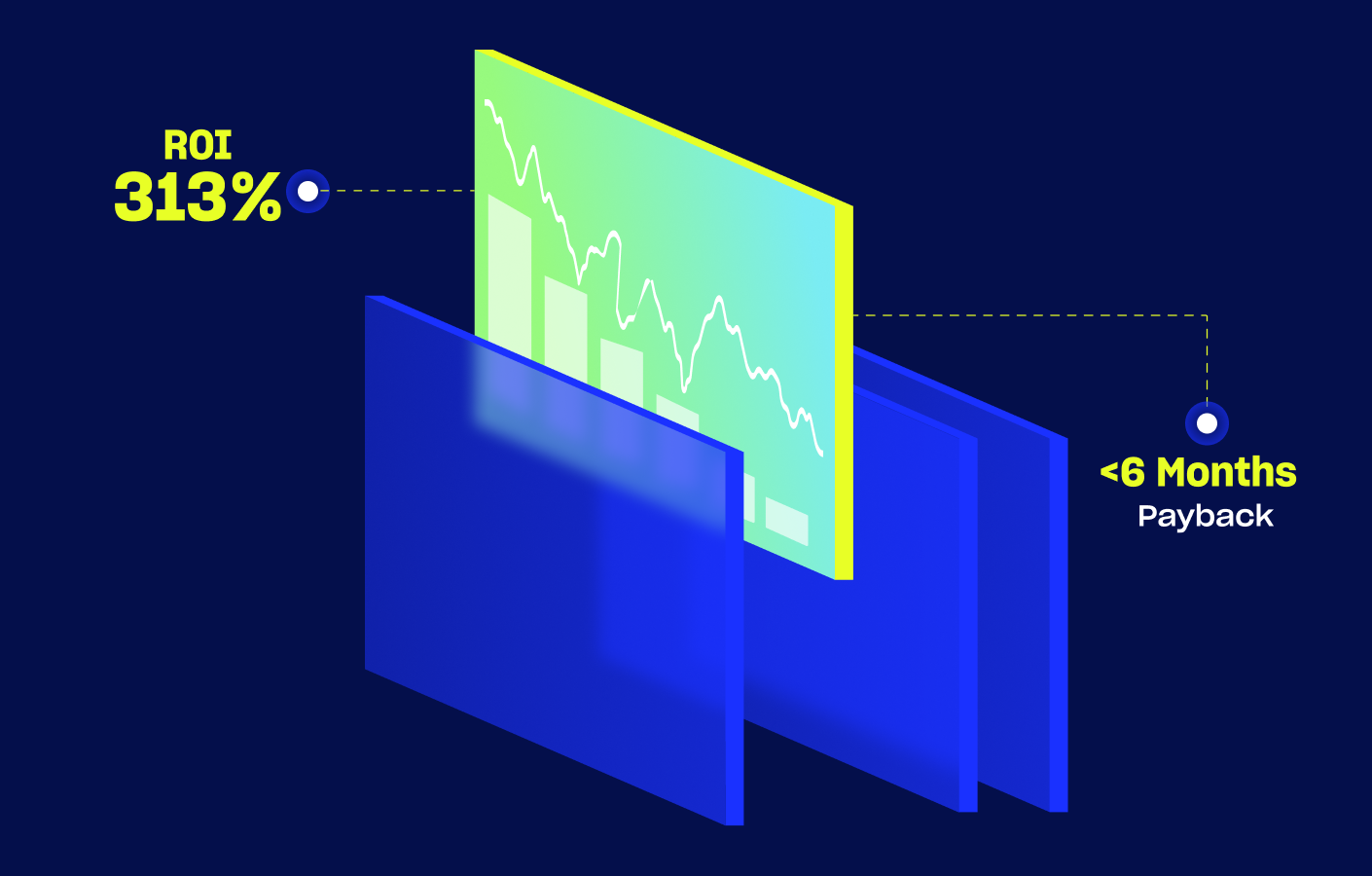
313% ROI
$2.7 million net present value
Payback in less than six months
$3.6 million in three-year risk-adjusted present value benefits
Those numbers matter. They help quantify the business case. But the more useful question for IT leaders is not just what the modeled return was. It is where that return came from, and what it says about the way modern incident operations need to change.
This study is not just about ROI
The headline ROI matters. It gets attention. It helps justify investment. But the real value of a TEI study is that it shows where the economic impact comes from.
In this case, the benefits are far from abstract. They are tied to the operational failure points most teams already know too well:
Too many alerts
Too much manual triage
Too much time spent correlating signals across fragmented tools
Too many escalations
Too much downtime risk
Too much senior engineering time spent on work that should not require senior engineers
This study gives IT and operations leaders a concrete way to think about what AI should be doing in production environments, not generating more dashboards, but removing friction from incident workflows.
What the findings suggest about modern IT operations
The strongest signal in the report is not that Edwin AI is “faster” or “smarter.” It is that the traditional operating model has become too manual to scale.
The gains start early, then build over time. In the study, the composite organization achieved a 75% reduction in alert noise and a 60% reduction in time spent on root cause analysis (RCA) in Year 1, improving to 90% and 70% by Year 3. It also reduced mean time to resolve customer-facing P1 and P2 incidents by 40% in Year 1 and cut SLA-breaching P1/P2 incidents by 30%, with both measures improving further by Year 3.
Taken together, those findings show how improvements in one part of the incident lifecycle can strengthen the next.
Noise reduction by itself helps, but only to a point. Faster RCA by itself helps, but only after the incident has already become serious. The real operational change happens when these capabilities stack:
Fewer irrelevant alerts reach engineers
Related signals are grouped earlier
Context is surfaced sooner
Teams spend less time guessing
Incidents get resolved faster
Fewer customer-facing events turn into larger business problems
That is what IT leaders should take from this study. The benefit is a different operating model for incident response.
Incident work has outgrown manual correlation
Most operations teams are managing environments that were not designed for today’s level of dependency and change. Hybrid infrastructure, cloud services, distributed applications, and fragmented tools have increased the number of signals teams need to interpret during an incident. The work has become more interconnected, while the response process often still depends on manual correlation.
That creates a familiar pattern: teams spend too much time sorting the conditions around an incident before they can address the issue itself.
In the study, interviewees described this problem in direct terms. One chief customer service officer in IT services said, “The number of alerts was simply too high. On a daily basis, we were averaging more than 10,000 alerts, which made it impossible to proactively manage alerts and incidents.”
A platform owner in IT services described the same issue at the tooling level: “We had too many systems and platforms in place, and the tooling was fragmented. Without a single, standardized platform, it was difficult to connect signals across environments and respond efficiently.”
That is the practical problem Edwin AI is meant to address. AI only matters here if it helps teams make signal usable sooner: fewer duplicate alerts, clearer incident context, faster root cause analysis, and less time spent moving between disconnected systems.
How to use this TEI study
A TEI study is most useful when you use it to evaluate your own operating model. The headline financial metrics matter, but the better read is in the assumptions, benefit categories, and workflow changes behind them.
1. Compare the study to your current incident workflow
Start with the conditions the TEI study models:
alert fatigue
duplicate incidents
slow triage
prolonged root cause analysis
avoidable downtime
SLA exposure
skilled engineers spending time on repetitive incident work
If those conditions sound familiar, the study gives you a practical way to assess where your current incident process may be costing more than it should. The point is to connect the financial model to the work your teams already perform every day.
2. Bring the right stakeholders into the conversation
The value of Edwin AI will look different depending on who is evaluating it.
Operations leaders may focus on alert volume, triage effort, MTTR, and incident throughput. Engineering leaders may focus on how much expert time is spent on repetitive investigation and escalation work. Service owners may focus on uptime, SLA performance, and customer-facing impact. Finance leaders may focus on cost avoidance, payback period, and the relationship between benefits and total investment.
3. Use the model as a benchmark
The study is based on a composite organization, so the results should be read as a model rather than a forecast for every company. Use it to pressure-test your own assumptions:
Is your alert volume higher or lower?
How much of your triage process is still manual?
How often do P1 and P2 incidents affect customer-facing services?
What does downtime cost your business?
How material are SLA penalties or service credits?
How much L2 and L3 time goes into root cause analysis?
How much effort goes into maintaining alerting rules, routing logic, and event-management workflows?
The value of the report is in helping you ask more precise questions before building a business case.
4. Identify the first workflow worth improving
The best starting point is usually the workflow where manual effort is measurable and tied to business impact.
A better approach is to start where the cost of operational friction is highest:
alert correlation
incident enrichment
root cause acceleration
customer-facing outage response
repetitive triage workflows
A useful first use case should have a clear baseline, repeatable workflow, and outcome that matters beyond one team. Alert noise is often a strong entry point because it affects triage, escalation, root cause analysis, and engineering capacity at the same time.
What customer validation adds to the study
The TEI study gives readers a financial model. The customer validation alongside helps explain why the benefit categories matter in the first place.
The numbers in the study are organized around measurable outcomes: reduced alert noise, faster root cause analysis, lower MTTR, fewer SLA-breaching incidents, and less time spent managing prior event-management workflows. That structure is useful for a business case, but it can make the work sound cleaner than it feels inside an operations team.
The customer interviews add that missing layer. They show how those categories overlap during an actual incident.
One network manager in IT services described the problem this way: “The main callout from customers was around SLAs. We had a lot of breaches and a lot of tickets that were false positives. We were focusing on issues that weren’t critical instead of prioritizing based on impact, and we didn’t have clear dependency mapping between devices, which made it difficult to address the most impactful problems first.”
That quote connects several parts of the business case at once: false positives increase triage effort, poor dependency mapping slows prioritization, slow prioritization increases SLA exposure, and SLA exposure turns an operations problem into a financial one.
A global head of IT networks in agriculture made a related point from the other side of the workflow: “We know about problems quicker, we get to the root cause faster, and we’re not being bombarded with noise like a site issue triggering 50 device alerts. Edwin AI does that correlation work for us and tells us roughly where the issue is, and most of the time that’s exactly where it is.”
Alert correlation is not only a queue-management improvement. It changes the quality of the investigation that follows. When related signals are grouped earlier, the team starts closer to the likely cause, and senior engineers spend less time reconstructing the incident from scattered evidence.
These interviews are useful because they make the study easier to apply. The question is where your team sees the same pattern: high alert volume, weak signal quality, unclear dependencies, repeated escalation, slow RCA, or service risk that grows because teams cannot identify impact quickly enough.
Read the study with your own environment in mind
Use the study to examine where incident response is costing your team time, budget, and focus.
Start with the parts of the workflow that are easiest to inspect.
Where does alert noise still create measurable waste?
Which incidents still require engineers to correlate signals across tools by hand?
Where are senior engineers getting pulled into work that could be handled earlier in the process?
What do customer-facing outages, SLA misses, or delayed escalations cost the business?
Which workflow would show value fastest if the manual effort around it were reduced?
Those questions make the study more useful. They turn the model into a way to evaluate your own operating constraints, instead of treating it as a generic proof point.
This study gives IT leaders a disciplined way to assess the potential financial impact of Edwin AI. The broader takeaway is more practical: modern operations teams need more than visibility. They need incident workflows that reduce noise, preserve attention, shorten investigation, and help teams act with better context.
That is where the business case starts.
Read the Forrester Consulting Total Economic Impact™ study to see the full methodology, assumptions, cost model, and benefit breakdown for LogicMonitor Edwin AI.
Margo Poda leads content strategy for Edwin AI at LogicMonitor. With a background in both enterprise tech and AI startups, she focuses on making complex topics clear, relevant, and worth reading—especially in a space where too much content sounds the same. She’s not here to hype AI; she’s here to help people understand what it can actually do.
Disclaimer: The views expressed on this blog are those of the author and do not necessarily reflect the views of LogicMonitor or its affiliates.