MCP and A2A: What They Are and Why They Matter for Autonomous IT
Model Context Protocol (MCP) and Agent2Agent (A2A) define how AI agents access enterprise systems and coordinate across workflows, forming the architectural foundation for governed, production-ready agentic IT operations.
MCP and A2A are the two protocols that make agentic AI governable at enterprise scale. One controls how agents use tools, and the other controls how agents work together.
Without MCP, agent actions on enterprise systems are unstructured, unauditable, and ungovernable
Without A2A, multi-agent workflows collapse into brittle point-to-point integrations
Together, they’re the architectural foundation that separates a production-ready agentic system from a demo
AI in the enterprise is no longer confined to chat windows. It’s operating inside incident queues and automation pipelines. Increasingly, teams are using AI agents to take action: detecting incidents, executing remediations, updating tickets, coordinating across systems.
This shift requires infrastructure that many organizations haven’t thought carefully about yet. Specifically, two open protocols that are becoming the standard for how enterprise agents are built and governed.
Model Context Protocol (MCP) controls how agents interact with tools, like APIs, automation engines, ITSM platforms. .
Agent2Agent Protocol (A2A) controls how agents interact with each other, like delegating tasks, sharing context, coordinating across workflows.
They solve different problems, and in IT operations, you need both.
Model Context Protocol (MCP): Governed Agentic Access to Tools and Systems
In enterprise IT environments, AI agents are built to query observability data, retrieve logs, update ITSM tickets, execute automation playbooks, and push status back into operational systems. These are bounded, structured interactions with defined inputs and outputs.
The Model Context Protocol (MCP) defines how these AI agents interact with tools and external systems in a structured, governable way.
MCP allows tools to describe their capabilities in a machine-readable format, defines how agents pass parameters, enforces structured responses, and creates a controlled boundary between AI reasoning and enterprise systems. That boundary is where governance lives, by which we mean role-based access control, audit logging, change management integration, approval workflows, and policy-based execution.
Without that structure, agent behavior is opaque. You cannot answer basic questions about what an agent accessed, what it changed, or whether it was authorized. However, with MCP, every tool call is traceable, every boundary is enforceable, and execution becomes something auditable.
Agent2Agent (A2A): How Agents Coordinate
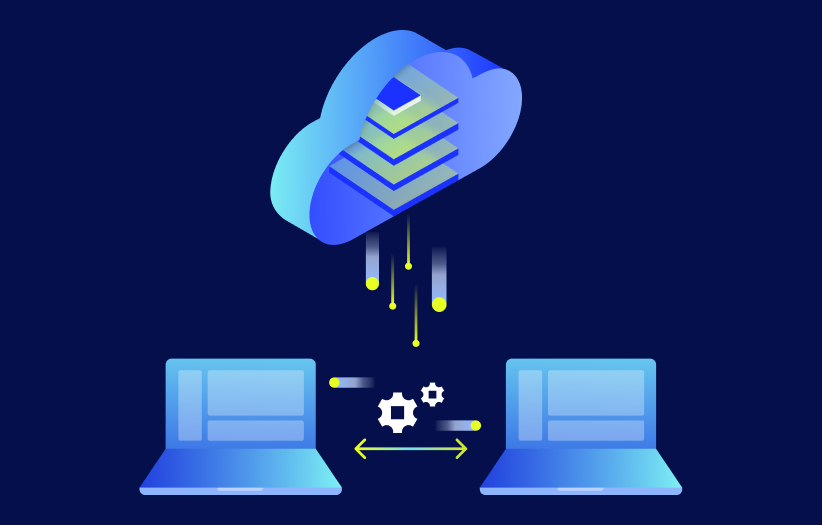
If MCP governs how agents use tools, Agent2Agent (A2A) governs how agents work with each other.
Complex enterprise workflows rarely fit inside a single agent. In IT operations, an event intelligence agent might detect correlated alerts, while a separate investigation agent handles root cause analysis, a remediation agent determines corrective action, and a change management agent validates execution.
Each agent is specialized, and each may use tools internally through MCP. But once multiple agents are involved, they need a structured way to coordinate, hand off work, share findings, and move a task forward without losing context. A2A provides.
A2A defines how independent agents:
Discover each other
Assign or accept tasks
Share relevant context
Coordinate across multiple steps
This is not a simple request-and-response exchange. It’s collaboration between systems that reason over goals.
The difference is straightforward:
Tools execute defined actions.
Agents pursue outcomes.
A2A is built for systems that pursue outcomes together.
It also makes multi-agent architectures practical. Each agent stays focused on its domain. A2A is the layer that connects them without forcing them to merge into one oversized, brittle system.
Why the Separation Matters
When tool execution and agent coordination are collapsed into one layer, boundaries blur. Actions that should be tightly governed start behaving like open-ended conversations. Conversations that require flexibility get forced into rigid transaction patterns.
That’s where systems become brittle.
Tool execution needs strict controls. If an agent updates a ServiceNow ticket or runs a remediation playbook, the interaction must be permissioned, validated, and logged. That is an execution problem.
Agent collaboration is different. When agents coordinate an investigation or sequence remediation steps, they need room to share context, revise decisions, and hand off responsibility. That is a reasoning problem.
Trying to solve both with one protocol leads to predictable issues:
An agent touching production systems operates within strict governance.
Agents collaborating across a workflow retain flexibility without breaking those controls.
As autonomy increases, these boundaries matter more. Protocol discipline is what keeps autonomy from turning into operational risk.
How MCP and A2A Apply in IT Operations
Understanding the separation conceptually is one thing. Seeing where each protocol does its job in a real environment is another.
IT operations is not a greenfield environment. It is a layered ecosystem of monitoring tools, ticketing systems, automation engines, cloud platforms, and change controls. Any serious AI agents operating here must integrate cleanly into that structure.
Consider a typical incident lifecycle:
Alerts are ingested and correlated.
An incident is created in ITSM.
Logs and metrics are analyzed.
The root cause is identified.
A remediation workflow is executed.
A change record is updated.
Post-incident reporting is generated.
Every step above involves both tool interaction and agent coordination — and the protocol required changes depending on which is happening.
So, when an agent pulls logs, queries topology, runs an Ansible playbook, or updates a ServiceNow ticket, those actions need to be structured, permissioned, and auditable. That’s MCP.
When agents delegate triage, share investigation findings, sequence remediation steps, or validate impact across systems, that coordination needs to support state, evolving context, and negotiated handoffs. That’s A2A.
In practice, this means a mature ITOps architecture might include a dedicated event intelligence agent, an investigation agent, a knowledge agent, a remediation agent, and a change governance agent. Each uses MCP internally to access its tools. All of them depend on A2A to coordinate across the full incident workflow.
That layered structure is what allows enterprises to increase autonomy without losing control. Tool execution stays governed. Agent collaboration stays modular. And the system can scale across hybrid environments without governance breaking down at the seams.
Governance, Security, and Enterprise Control with MCP and A2A
That architecture only holds if the agents inside it can be trusted — and in enterprise environments, trust is enforced, not assumed.
As agents gain the ability to restart services, modify configurations, and update production records, one question becomes more important than any other: not whether the agent can do something, but whether it’s authorized to — and whether there’s a record proving it stayed within bounds.
MCP answers that question at the execution layer. Role-based access, scoped permissions, approval workflows, parameter validation, full audit trails — all of it is structural, not optional. Every tool call is traceable. The boundary between what an agent can attempt and what it’s actually permitted to do is explicit and enforced.
In IT operations this is non-negotiable. A remediation agent touching production infrastructure carries the same risk profile as a human engineer doing the same thing. It needs the same controls.
A2A governs a different surface. Collaborating agents don’t need to share internal memory, reasoning chains, or proprietary logic — only what’s necessary to coordinate on a task. That keeps security boundaries intact and limits data exposure across agent boundaries.
The practical result: agent autonomy can increase without governance eroding alongside it. More capability, same accountability.
The Direction of Multi-Agent Adoption
Most organizations are still running a single AI assistant layered on existing systems. That model doesn’t hold as environments grow more complex. Specialization becomes necessary, because one agent cannot efficiently handle detection, diagnosis, remediation, reporting, and governance across hybrid infrastructure.
As an organization’s automation maturity increases, the architecture shifts toward specialized agents, each narrower in scope and more capable within its domain. Internally, each agent uses MCP to access its tools. Across the workflow, they coordinate via A2A.
Eventually, agents may collaborate across organizational boundaries — with vendors, partners, and managed service providers. That level of interoperability requires a shared, neutral protocol layer. A2A provides that neutrality. MCP provides controlled access underneath.
The progression from single assistants to coordinated multi-agent ecosystems is only stable if the underlying architecture can support it. Protocol separation is what keeps autonomy from outpacing accountability.
See how AI automation will shift your team from reactive to proactive with Edwin AI.
Margo Poda leads content strategy for Edwin AI at LogicMonitor. With a background in both enterprise tech and AI startups, she focuses on making complex topics clear, relevant, and worth reading—especially in a space where too much content sounds the same. She’s not here to hype AI; she’s here to help people understand what it can actually do.
Disclaimer: The views expressed on this blog are those of the author and do not necessarily reflect the views of LogicMonitor or its affiliates.